Plywood RTA Cabinets: Why the Box Matters
A cabinet door gets opened a few thousand times; the box behind it holds the counter, the drawers and the wall. CasaBuilt publishes four gauges for that box: a 1/2-inch birch plywood carcass, a 3/4-inch solid birch face frame, 5/8-inch dovetail drawers and 3/4-inch shelves. Those four numbers explain more about how a kitchen ages than any finish sample does.
Key takeaways
- The carcass is 1/2-inch birch plywood, which converts to 12.7 millimeters.
- The face frame and the shelf are both 3/4 inch, or 19.05 millimeters.
- Drawer sides are 5/8 inch, or 15.88 millimeters, and joined with dovetails.
- Plywood is a laminated panel: alternating plies are what keep a box square as humidity changes.
What a cabinet box is asked to do
Strip the door and the drawer fronts away and a cabinet is a five-sided wooden box with a frame on the front. It has to hold a countertop flat, keep two side panels parallel, carry the weight of everything stored inside, and accept hinges and drawer glides that will be adjusted for years. None of that work happens in the door panel, which is why a beautiful door on a weak carcass is a short-lived bargain.
CasaBuilt's published construction is a 1/2-inch birch plywood box with a natural birch interior and color-matched exterior sides. The front is a face frame of 3/4-inch by 1-1/2-inch solid birch. Doors are a rubberwood frame around an MDF panel in a Slim Shaker profile with full overlay, hung on concealed soft-close hinges with six-way adjustment. Drawers are 5/8-inch rubberwood, dovetailed, running on soft-close undermount glides with full extension. Shelves are 3/4-inch plywood, adjustable, with a half-depth shelf in the base cabinets.
Read as a list, that is a specification. Read as a structure, it is a load path: shelf to side panel, side panel to face frame, face frame to hinge, hinge to door. The gauges are chosen for the part of the path each one carries.
Four gauges, one structure
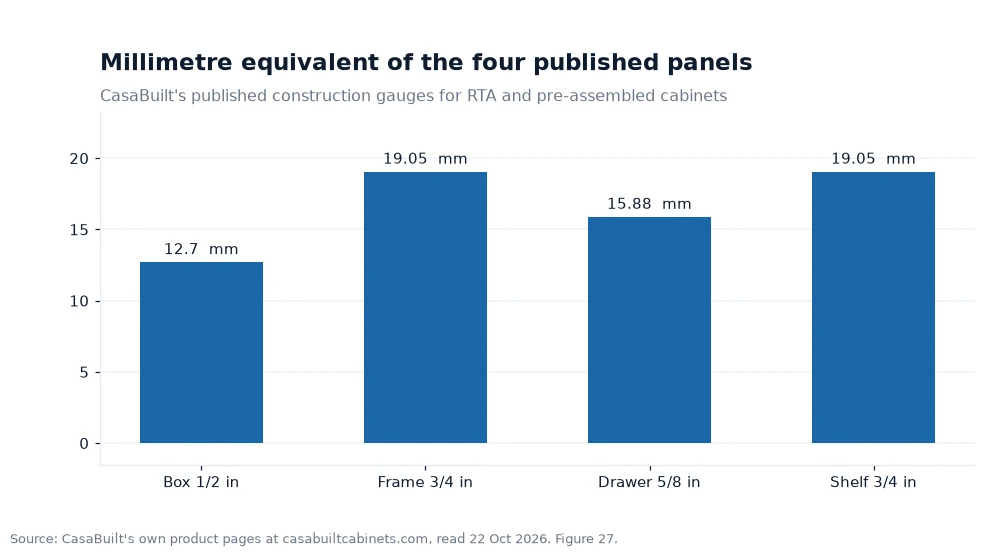
The chart converts the published inch measurements to millimeters, which is how most panel goods are specified at the mill. The conversion is not cosmetic. It shows how thin the carcass actually is next to the parts that take the moving loads.
| Panel | Published gauge | Millimeters | Job in the box |
|---|---|---|---|
| Box side and back | 1/2 in | 12.70 | Holds the box square and carries shelf load to the floor |
| Face frame | 3/4 in | 19.05 | Takes hinge screws and stiffens the open front |
| Drawer side | 5/8 in | 15.88 | Carries the loaded drawer on its glides |
| Shelf | 3/4 in | 19.05 | Spans the cabinet width without a sag line |
What stands out is the relationship, not the individual figures. The carcass is the thinnest panel in the cabinet and the only one that is not meant to move. It holds its shape because it is a plywood panel with crossed plies, and because the 3/4-inch face frame and the fixed back do the bracing that a single panel cannot do alone.
CasaBuilt sells this construction across its plywood rta cabinets collection, and the same gauges appear in the pre-assembled range. The 16 door samples in stock exist so a buyer can check the face; the gauges are what a buyer checks when the drawer is open.
The materials the box replaces
Not every cabinet at this price is built from plywood. The common alternatives are furniture board, which is a particleboard panel with a thin foil or paper face, and MDF, a dense fiber panel with a smooth, uniform surface. Both are flat, stable in the short term and cheap to machine, and both behave badly at a cut edge in a wet room.
A glued particleboard panel is a mat of chips held together with resin. Water that reaches an unsealed edge swells the chips, and the panel does not return to its original thickness when it dries. The damage usually starts where it cannot be seen: the bottom edge of a sink base, the back of a panel against an outside wall, the screw holes where a hinge was fitted. MDF behaves in a similar way, slower to start and harder to repair.
Plywood is built from veneers peeled from a log and glued in alternating grain directions. The alternating layers resist movement along the face, and the panel holds its fasteners better at an edge because a screw passes through several plies rather than into a field of chips. That is the engineering case for the box, and it is why the 12.7-millimeter side panel can be thinner than the 19.05-millimeter frame and still do its job.
None of this makes plywood indestructible. A leak left running for a month will ruin a plywood cabinet as surely as any other. The difference is how much time the material buys before the damage becomes structural.
Edges, joints and the finish line
The cut edge is where a plywood panel is most vulnerable, because the end grain of every ply is exposed. The door finish is seven coats of paint plus a UV topcoat, and the outside of the box is color-matched to it. Inside, the birch is left bare: a working surface rather than a display one.
A buyer comparing two quotes should ask what happens at the bottom edge of the sink base and at the back panel. Those two places decide whether a small leak becomes a stained shelf or a swollen carcass. The 1/2-inch box gives less material to absorb water than a thicker panel, so sealing and ventilation matter more, not less.
Joints carry the same argument. Dovetail drawer corners interlock, so the drawer side and the drawer front resist pulling apart when the drawer is loaded and yanked. A stapled butt joint relies on the fasteners alone. The published details also include soft-close hinges with six-way adjustment, which lets an installer correct a door that arrives slightly out of plane without drilling new holes, and a one-year warranty against manufacturing defects, described on the warranty page.
Worked example
Convert each published gauge by multiplying inches by 25.4. The box: 0.5 x 25.4 = 12.70 mm. The face frame: 0.75 x 25.4 = 19.05 mm. The drawer side: 0.625 x 25.4 = 15.875, shown as 15.88 mm. The shelf: 0.75 x 25.4 = 19.05 mm.
Now compare them. The frame is 19.05 / 12.70 = 1.50 times the thickness of the box, so the front of the cabinet is half again as thick as its sides. The drawer side is 15.88 / 12.70 = 1.25 times the box, a quarter thicker, because it takes the pull of a loaded drawer. The shelf matches the frame at 19.05 mm, and it sits 19.05 - 15.88 = 3.17 mm thicker than the drawer side, which is the eighth of an inch that keeps a loaded shelf from bowing between the sides.
Add the four published gauges: 12.70 + 19.05 + 15.88 + 19.05 = 66.68 mm. If all four parts were built from the 12.70 mm box panel, the total would be 4 x 12.70 = 50.80 mm. The difference, 66.68 - 50.80 = 15.88 mm, is exactly the drawer gauge, which is a tidy way of saying that the extra material in this cabinet sits in the three panels that move or span, not in the sides that only hold.
Frequently asked questions
Is a half-inch plywood box strong enough for a kitchen?
For a cabinet with a solid face frame and a fixed back, yes. The 12.7 mm sides are braced by the 19.05 mm frame at the front and the back panel at the rear, and the shelf and drawer loads travel through those parts. A frameless cabinet relies on the side panel alone, which is why panel thickness matters more in that design.
What is the difference between plywood and furniture board?
Plywood is layers of veneer glued in alternating grain directions, so it resists swelling and holds screws at an edge. Furniture board is a particleboard panel with a decorative face, and its cut edges swell when water reaches them. The two can look identical behind a door and behave very differently under a sink.
Does the drawer gauge matter if the drawer runs on glides?
It does. The glides carry the drawer, but the drawer side carries the contents and transfers that load into the dovetail corners and the glide clips. A 15.88 mm rubberwood side with dovetail joints keeps the box square when a full drawer is pulled out to its full extension.
Look at the carcass before the door
Ask for the box gauge, the frame width and the drawer thickness before choosing a finish, and put the same three questions to every quote you collect. Order a sample door to judge the face, then open a display cabinet or read the specification for the part you cannot see. The door is what visitors notice; the box is what the kitchen stands on.
Figures quoted here come from the manufacturer's own website, read 22 Oct 2026[1].